



Quick Summary:
E-commerce AI is evolving from single, isolated chatbots to multi-agent systems that support end-to-end business workflows. Businesses use AI agents for product recommendations, customer support, order processing, inventory management, cart recovery, marketing, pricing, and promotions. The big change is from AI that just generates responses to systems that can understand context, reach into connected business data, take specified actions and work with other agents where necessary. “Successful adoption relies on trusted integrations, clear agent responsibility, strong security, oversight by humans, and a well-thought-out AI automation strategy.”
Introduction
Today, e-commerce businesses are facing much more than just shopfronts online. They are managing large product catalogues, customer conversations, orders, inventory, marketing campaigns, pricing decisions, returns and multiple sales channels simultaneously. When operations get more complicated, throwing more manual processes at a problem is rarely a sustainable solution.
This is the place where multi-agent artificial intelligence systems are revolutionising e-commerce operations. Rather than one AI assistant or a suite of disconnected automation tools, businesses can deploy multiple specialised AI agents that collaborate, share information, make decisions and execute tasks across multiple systems.
For an e-commerce business, this can mean faster order processing, more responsive customer service, better visibility into inventory, personalised shopping experiences, and fewer repetitive tasks for internal teams.
Multi-Agent Artificial Intelligence Systems: What Are They?
Multi-agent AI system is an architecture where multiple specialised AI agents work together to achieve a larger business goal.
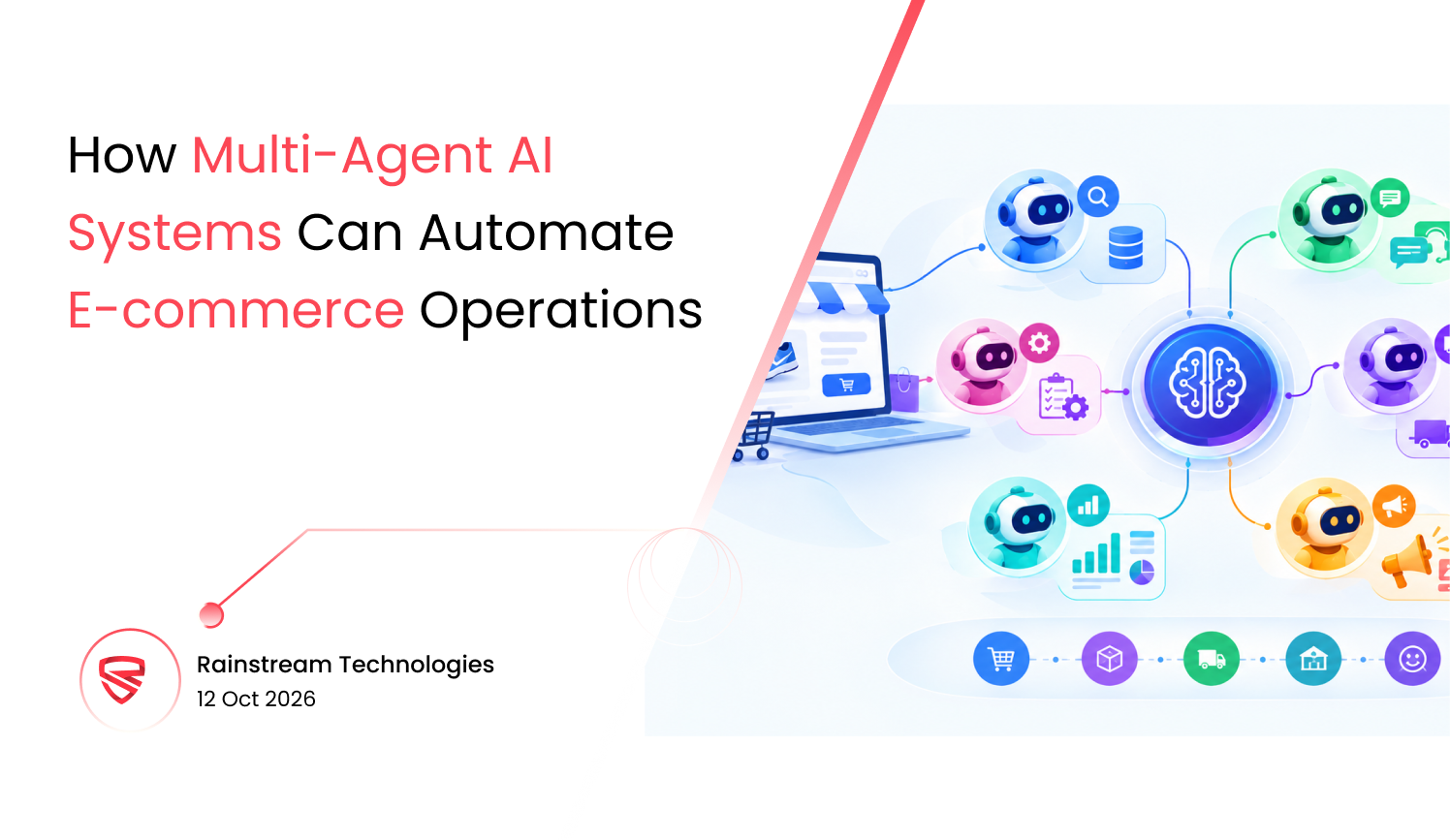
Each agent can have a certain role. E.g. an e-commerce operation could utilise:
 A product agent to manage product data and recommendations
- Customer support agent to answer questions and resolve common problems
- Process orders Provide status updates to order agent
- An inventory agent for stock tracking
- A marketing agent to customise campaigns and follow ups
- Pricing agent to analyse demand and promotion opportunities
These agents can talk to each other across a central workflow/orchestration layer instead of operating independently.
That is a big difference. The typical automation process is guided by well-defined instructions: if an event occurs, then perform a specific action. Multi-agent systems are able to comprehend information, make decisions about next steps, employ linked tools, and collaborate with other agents .
It produces a more flexible kind of AI workflow automation, for workflows with many decisions and systems.
Why is AI Automation Needed in E-commerce?
There is a lot of action going on in the e-commerce operations on a daily basis.
The customer journey can be across discovery of product, recommendations, questions, cart activity, payment, order processing, fulfilment, updates on delivery, and support after purchase.
Behind the scenes, teams may also need to update inventory, manage product data, adjust promotions, monitor sales performance and coordinate marketing campaigns.
All of this manual work creates a lot of problems:
- Tedious administrative tasks
- Sluggish response times
- Inconsistent customer experience
- Errors in inventory management
- Decisions postponed
- Increased cost of operation
- Scaling difficulty at peak demand
Automation can free employees to work on activities that require strategy, creativity, negotiation and human judgement, while automating repetitive operational work.
The bigger opportunity comes when you link these automations together.
Rather than automating isolated tasks, businesses can now build an intelligent ecosystem in which customer activity, inventory data, orders, marketing signals and business rules all contribute to what happens next.
Check out our case study: AI-Driven Industrial Automation Platform
How does e-commerce multi-agent AI work?
In a multi-agent e-commerce architecture, there is usually a collection of specialised agents that interface with business systems and data sources
For example, a customer goes to an online store and searches for a specific product.
It may look something like this:
Step 1: Customer interaction
The customer is asking for a product or looking for a product.
Step 2: Customer agent intent analysis
The customer service agent finds out what the shopper is trying to do and gets the relevant information.
Step 3. Product agent evaluates options.
A product recommendation agent considers the product attributes, the customer’s preferences, the past behaviour and the availability.
Step 4: Stock agent – check stock
The inventory agent verifies availability in real time from warehouses or sales channels.
Step 5: The pricing agent reviews the offer
If applicable, the pricing agent will validate current promotions, pricing rules, customer eligibility, and inventory conditions.
Step 6: Action of order agent
Once the customer has purchased, the order agent starts the correct order workflow and communicates with other connected systems.
Step 7: Marketing agent continues journey.
Once a purchase has been made, a marketing agent can perform relevant follow-ups, cross-sell recommendations or retention campaigns.
The whole system is built around handling the customer journey, with each agent having a specific role to play.
This is really useful when an e-commerce business has many platforms, APIs, databases, CRMs, ERP software, payment providers, logistics tools and marketing platforms that need to work together.
AI Agents Can Automate Critical E-Commerce Tasks
1. Product Recommendations
Product discovery is one of the strongest opportunities for intelligent automation.
A recommendation agent can analyze signals such as:
- Browsing behavior
- Previous purchases
- Search queries
- Product preferences
- Cart activity
- Product relationships
- Current inventory
- Seasonal trends
Instead of showing the same recommendations to every visitor, the system can dynamically select products based on the shopper’s context.
For example, someone purchasing a professional camera may receive recommendations for compatible lenses, memory cards, batteries, or accessories.
This can improve product discovery while creating opportunities for cross-selling and upselling.
2. Customer Support
Customer support teams often spend significant time answering repetitive questions.
AI agents can handle common requests such as:
- Order status
- Shipping information
- Product availability
- Return policies
- Refund status
- Product specifications
- Delivery estimates
- Basic troubleshooting
More importantly, an agent can retrieve information from connected systems rather than simply providing static answers.
If a customer asks, “Where is my order?”, the system can identify the order, retrieve the latest tracking information, and provide a contextual response.
When an issue requires human intervention, the agent can escalate the conversation with the relevant information already collected.
3. Order Management
Order processing involves several steps that can be coordinated automatically.
An order management agent can:
- Validate order information
- Check inventory
- Trigger fulfillment workflows
- Communicate with shipping systems
- Send customer notifications
- Monitor order status
- Flag exceptions
- Assist with cancellation or return requests
This reduces the amount of manual coordination required between e-commerce teams, warehouses, customer support, and logistics providers.
4. Inventory Management
Inventory problems can quickly affect revenue and customer satisfaction.
An inventory agent can continuously monitor stock levels and identify unusual patterns.
It can help businesses:
- Detect low-stock products
- Identify fast-moving items
- Monitor inventory across locations
- Flag potential stockouts
- Support replenishment decisions
- Compare demand against available inventory
- Coordinate inventory information across channels
For businesses selling through multiple channels, connected inventory intelligence can also reduce discrepancies between storefronts and backend systems.
5. Cart Abandonment
A customer adding a product to their cart does not necessarily mean they will complete the purchase.
A cart recovery agent can analyze abandonment signals and determine an appropriate response.
Depending on business rules, it may:
- Trigger a reminder
- Recommend alternative products
- Answer questions about the product
- Highlight relevant benefits
- Provide shipping information
- Escalate a high-value customer to a sales representative
The key advantage is contextual engagement rather than sending the same reminder to every abandoned cart.
6. Marketing Automation
Marketing teams manage numerous campaigns, customer segments, channels, and messages.
AI agents can help coordinate these activities by analyzing customer behavior and triggering relevant actions.
Potential applications include:
- Personalized email campaigns
- Product recommendations
- Customer segmentation
- Lead nurturing
- Retargeting workflows
- Post-purchase campaigns
- Customer retention programs
- Cross-selling opportunities
A marketing agent can also work with customer and product agents to create more relevant campaigns based on real-time information.
7. Pricing and Promotions
Pricing decisions often depend on several variables.
These can include:
- Demand
- Inventory levels
- Competitor activity
- Seasonal periods
- Product performance
- Customer segments
- Promotional rules
A pricing agent can analyze these signals and recommend or execute pricing actions within predefined business boundaries.
Human oversight remains important for sensitive pricing decisions, but AI can significantly reduce the time required to identify opportunities and anomalies.
Traditional automation works very well when the workflow is predictable.
For instance: When an order is placed -> send confirmation email.
The workflow is simple and does not need much interpretation.
Multi-agent AI is more useful when a process has changing information, multiple decisions, or multiple systems.
For example: Customer enquires about a product we don’t have → understand customer’s request → search for similar products → check stock → compare prices → recommend alternatives → respond to customer
In a traditional rule based workflow this can become complicated if all possible scenarios need to be defined manually.
A multi-agent architecture can partition these responsibilities among specialised agents.
| Conventional Automation | Multi-Agent AI |
|---|---|
| Follows predefined rules and workflows | Adapts to context and changing inputs |
| Ideal for repetitive, standard workflows | Suitable for complex, dynamic workflows |
| Typically handles specific tasks | Multiple AI agents collaborate on different tasks |
| Offers limited decision-making flexibility | Supports context-based decisions |
| Requires manual rule updates when conditions change | Can adjust responses based on context and available data |
| Often relies on predefined integrations | Can connect multiple systems through suitable tools and integrations |
This is not to say that companies should swap every automation for AI. The best architecture often mixes traditional automation, APIs, business rules and AI agents.
Benefits of Multi-Agent AI in E-commerce
- Reduced Manual Labour: Agents can assume repetitive operational tasks that would have required constant employee involvement.
- Speedier Customer Response: AI agents can respond to routine customer questions 24 hours a day, 7 days a week without waiting for an agent.
- Improved Personalisation: Contextual analysis of customer behaviour enables more relevant recommendations and interactions.
- Enhanced Operational Efficiency: Connected agents can help to reduce the handoffs between departments and systems.
- More Scalability: Automation enables companies to process more transactions without adding the corresponding human labour.
- More Effective Business Data: Agents can pull data from CRM, e-commerce, inventory, ERP and other integrated systems to inform their decisions about operations.
- Consistent performance: Automation can consistently apply business rules across thousands of transactions and customer interactions.
- Speedier Decision-Making: Instead of waiting for teams to gather and analyse information manually, agents can surface the right signals and trigger predefined actions.
A Real-World Multi-Agent E-commerce Workflow
Consider an online fashion retailer gearing up for a seasonal sale. The business experiences a significant increase in traffic and order volume.
How a multi-agent workflow could function:
Inventory Agent: Checks inventory levels and alerts when products are near their reorder point.
Product Agent: Updates product information, availability and recommendations on sales channels.
Customer Agent: Handles product enquiries, size enquiries, delivery enquiries, and basic support requests.
Pricing Agent Reviews promotional rules and identifies products for approved discounts.
Marketing Agent: Creates customer segments based on the buying behaviour and launches relevant campaigns.
Order Agent: Receives orders, interfaces with fulfilment systems, handles exceptions.
Analytics Agent: Monitors performance and alerts to unusual changes in sales, conversion, inventory or customer activity.
Agents can exchange information via an orchestration layer. The inventory agent can tell if a product starts to become popular suddenly. Such information can impact recommendations, marketing activity and replenishment decisions.
Here is where the value of a multi-agent architecture becomes clear: the agents don’t just automate individual tasks; they coordinate business processes.
Difficulties in the Deployment of Multi-Agent AI
Multi-agent AI has the potential to create significant value, but implementation is not straightforward.
System Integration: Agents need trustworthy business data and tools. Integration of e-commerce platforms, CRM systems, ERP software, payment gateways, logistics providers and other applications can be technically complex.
Quality of Data: The performance of conventional artificial intelligence systems is limited only by the data they have access to. Bad results can be due to incomplete product data, outdated inventory data or incomplete customer data.
Access Control and Security: Agents may have access to sensitive customer, order, payment and business data. Each agent should have access to only what they are responsible for.
Decision Boundaries: Not every decision needs to be fully autonomous. Businesses need to figure out what an agent is capable of doing on its own and what decisions require human approval.
Monitoring & Evaluation: Regular surveillance of agent behaviour is required. Businesses should track accuracy, task completion, exceptions, failures and customer outcomes.
Cost Control: Using multiple AI agents and integrating them with multiple systems can increase the cost of infrastructure and model usage. Architecture should be built around a measurable business value.
How to Integrate Multi-Agent AI into E-commerce
If you’re going to be successful, it should start with business processes, not technology.
Identify High Value Workflows: First identify repetitive tasks that take up a lot of employee time or cause operational delays. Examples include order tracking, product updates, customer support, inventory monitoring and marketing follow-ups.
Define Duties of Agent: The purpose of each agent should be well defined.
Don’t create multiple agents with overlapping responsibilities unless you have a good architectural reason for doing so.
Map out your current systems: Identify the platforms and data sources the agents will need to access.
These may include:
- Shopify and other e-commerce platforms
- Customer relationship management (CRM) systems
- ERP software
- product data bases
- Inventory management systems
- Payment gateways
- Shipping platforms
- Marketing tools
- Software for customer support
Design the Orchestration Layer: Figure out how agents will communicate, share information, delegate tasks and respond to failures. This layer is important since a multi-agent system requires coordination, and not AI components that are isolated.
Set Boundaries: Data access rules, approvals, escalation, sensitive actions and failure handling rules. For example, an agent might recommend a change in price but want human approval before publishing it.
Start with a concrete use case: Don’t automate all of e-commerce at once. Start with a workflow that yields a business outcome that you can measure. Customer support, product recommendations, order management or inventory monitoring could be practical starting points.
Measure the performance Monitor metrics like:
- Success rate of the task
- Reaction Time
- Customer satisfaction
- Conversion Ratio
- Cart Abandonment Rate
- Processing time
- Manual work load
- Cost of operation
Leverage these results to optimise the system before scaling to other workflows. If you need specific help with implementation, you may work with an AI Agent Development Company to build, deploy, test, and integrate a solution into your existing e-commerce infrastructure.
The Future of E-Commerce Multi-Agent AI
The next wave of e-commerce automation will move beyond individual AI features to interconnected intelligent systems.
Businesses will do more than use AI for recommendations or chat support and will increasingly deploy coordinated agents across the entire customer and operational lifecycle.
Future systems might be able to:
- Sales and Customer Support Coordination
- Inventory Needs Forecasting
- Optimisation of promotional campaign
- Operational anomaly detection
- Navigating intricate customer journeys
- Independent merchandising enabled
- Connecting virtual and real-world commerce data
- Performance-based continuous improvement workflows
This change could make e-commerce platforms more responsive to real-time business conditions.
In conclusion, the future is not necessarily about handing over full control to AI. The task is to design systems where AI is able to make appropriate decisions and actions and where people are accountable for strategy, governance, exceptions and high-impact decisions.
For companies looking to make this transition, an Agentic AI Service Provider can help determine where autonomous agents are actually practical and where traditional software or human workflows are the better option.
Conclusion
Multi-agent AI platforms can transform e-commerce automation by linking specialised AI agents across customer experience, orders, inventory, marketing, pricing and operational workflows.
Their main advantage is not just that they can automate individual tasks. Simply put, a number of processes can work together as a coordinated system.
E-commerce companies can cut down on repetitive tasks, respond to customers faster, get more out of their operational data and scale up without the complexity growing as fast as the business.
The best approach is to establish a measurable business problem, define agent responsibilities clearly, bring the right systems together, put up the right guardrails, and expand at a slow pace.
With the growing capabilities of AI agents, multi-agent architectures are likely to become an important underpinning of intelligent e-commerce operations.
If your business is considering custom AI automation, you can Hire AI Agent Developer support to review your workflows, define the right architecture and build agents that integrate with your existing e-commerce ecosystem.
Frequently Asked Questions
Q. What is a multi-agent AI system in e-commerce?
A. A multi-agent AI system uses specialised AI agents to automate e-commerce tasks such as customer support, product recommendations, inventory management, order processing, and marketing.
Q. How does multi-agent AI differ from a chatbot?
A. A chatbot primarily answers questions, while multi-agent AI systems coordinate tasks, access business data, make context-based decisions, and automate workflows.
Q. What e-commerce tasks can AI agents automate?
A. AI agents can automate customer service, product recommendations, order processing, inventory tracking, abandoned cart recovery, pricing analysis, and marketing campaigns.
Q. Can multi-agent AI integrate with existing e-commerce platforms?
A. Yes, Multi-agent AI can integrate with e-commerce platforms, CRMs, ERPs, payment gateways, inventory systems, and marketing tools through APIs.
Q. Can multi-agent AI replace e-commerce employees?
A. No, Multi-agent AI primarily automates repetitive tasks, supports employees, and improves operational efficiency while allowing human oversight when needed.
Q. Can small e-commerce businesses use multi-agent AI?
A. Yes, Small businesses can start by automating one or two high-impact workflows to reduce manual work and improve productivity.
Q. How long does it take to implement multi-agent AI?
A. Implementation time depends on workflow complexity, system integrations, data availability, security requirements, and automation needs.
Q. How can a business get started with multi-agent AI?
A. Start by identifying repetitive tasks, defining measurable goals, selecting suitable AI agents, integrating business systems, and establishing human approval rules and performance metrics.
Prefer Rainstream ?
 Add to Preferred Sources

 Contact Us