



Quick Summary:
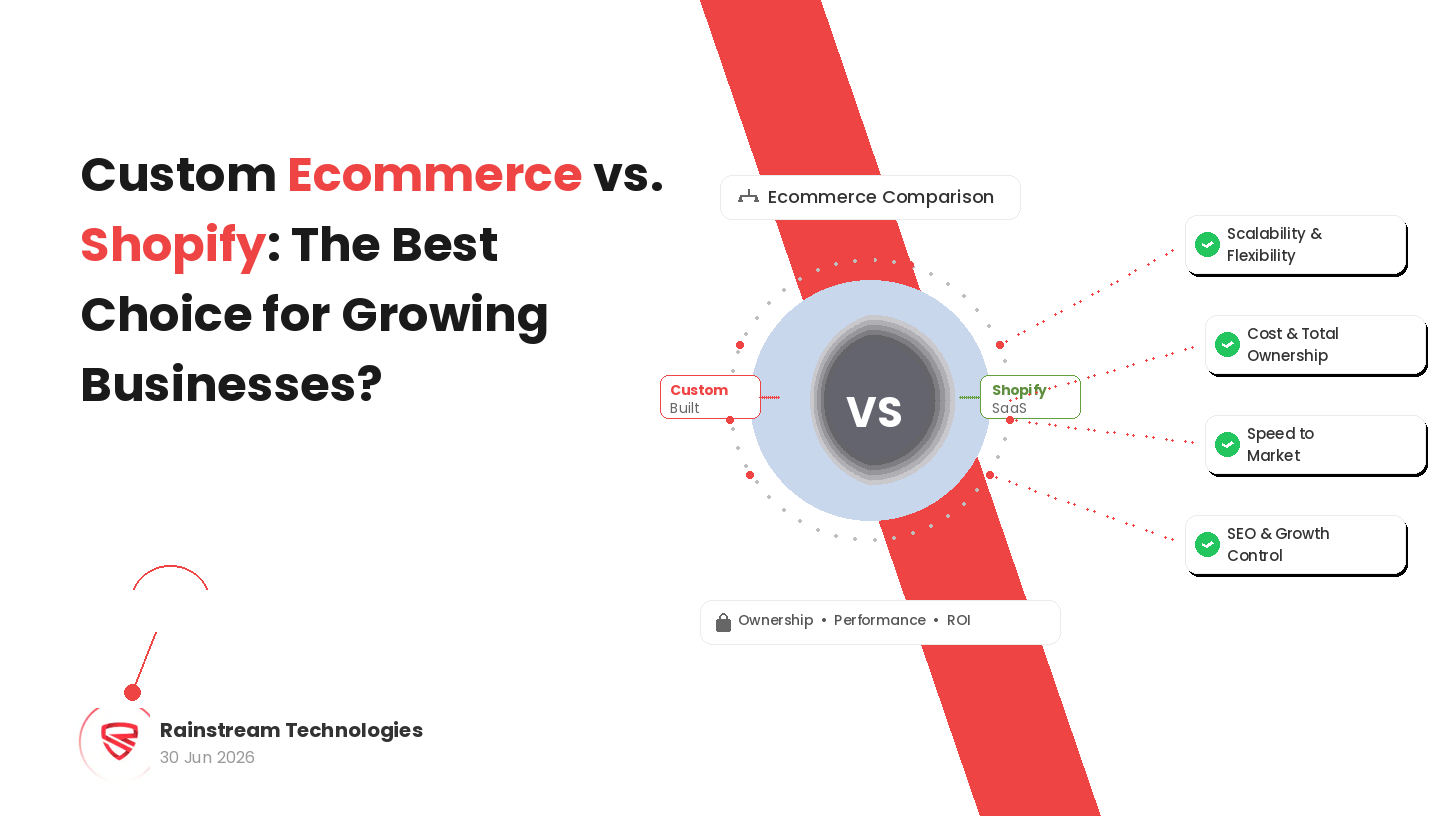
Choosing between a custom ecommerce website and Shopify depends on your business goals, growth plans, and operational needs. While Shopify offers a fast and reliable way to launch an online store, a custom ecommerce solution provides greater flexibility, scalability, and control as your business expands. This guide compares both options to help you determine which platform is the right fit for long-term success.
Introduction
Every growing business hits the same crossroad somewhere down the line. Are you building your online store with Shopify, or are you investing in a custom e-commerce platform built exactly how your business actually works? That decision will impact everything from your day-to-day operations to how much revenue you can realistically produce over the next five years. I have built and scaled shops on both sides of that divide, and the answer is never just following whatever is trending.
When you are making this call, this is what really counts.
The Scoop on Custom Ecommerce vs Shopify
Shopify is a hosted service that is billed on a monthly subscription. You sign up, choose a theme, and add your products, and you are selling. Hosting, security patches, uptime, and all that stuff are taken care of. That simple is, there’s a lot of truth to that for a lot of businesses, especially early-stage ones.
Custom e-commerce is a whole different approach. You are building a store from scratch, often on frameworks like Laravel, React, or Node.js. Your database, your hosting setup, and every feature is there because your business needs it. Nothing is borrowed from a template.
So the main trade-off is pretty clear. Shopify lets you sell faster. Custom gives you more control. What you need to work out is what trade-off makes sense for where your business is today and where it will be a year from now.
Features’ Contrast
Shopify offers a ton of great features right out of the box. Product management, discount codes, abandoned cart recovery, basic analytics, nice checkout flow. If you’re a typical retailer selling physical products, you can get started without writing a single line of code.
When your business model doesn’t fit the mold, the cracks begin to show. Subscription commerce, multi-vendor marketplaces, complex pricing tiers based on customer segments, dynamic bundling, and custom fulfillment workflows. These all push hard against what Shopify can do natively. There are apps for most of these, sure. But third-party apps mean dependency, extra cost, and slower page loads.
Custom e-commerce does not have those limitations. Selling regulated goods and need a five-step approval process in your checkout? You make it. Want a pricing engine that considers material weight, shipping zone, and customer tier all at once? You do that, as well. The platform bends itself around the business, not vice versa.
SEO Side by Side
Shopify does the basics of SEO well. You can edit title tags and meta descriptions; it generates sitemaps automatically, and url structures are fairly clean. In the last couple of years page speed and Core Web Vitals have improved substantially, which helps with rankings.
But if you have spent any real time doing SEO, you know where Shopify gets frustrating. You can’t remove “/collections/” or “/products/” from your URLs. The blog is simple. Limited control over schema markup, canonical tags on filtered pages, and pagination. For businesses fighting for rankings in competitive niches, those limitations start costing you real traffic.
Custom e-commerce gives you complete control of every SEO lever. You can build your URL architecture based on your keyword strategy from the get-go. Server-side rendering, advanced product schema, review markup, FAQ structured data, and internal linking the way search engines like it. If organic traffic is a serious revenue channel for your business, this level of control is often the reason to invest in proper e-commerce website development solutions.
Performance Comparison Table
Shopify is driven by a rock-solid infrastructure. Global CDN, reliable uptime, and handling flash sale traffic surges. Performance is not really a concern you need to have for most small and mid-sized stores.
But performance is not just about staying online. It’s about the actual speed of your pages loading when real customers are browsing. Every third-party app you install on Shopify adds JavaScript to your storefront. Themes have unused CSS. Liquid templating also has its own rendering bottlenecks. A Shopify store with fifteen apps is not the same as a fresh install. And most growing stores have far more than fifteen of them.
With a custom build, you control every asset, every script, and every database query. Edge caching, lazy loading, and code splitting: you put them right where they make the most difference. When shaving off a few hundred milliseconds can measurably boost your conversion rate, having that kind of control is worth having.
Comparison of Scalability
Shopify scales well when it comes to volume. Shopify Plus can take care of high-traffic stores and large product catalogs, and you don’t need to manage the infrastructure yourself. That’s a benefit, especially for lean teams.
Custom e-commerce scales to a new dimension. It is scalable. Need to integrate a warehouse management system that uses a proprietary API? Or your storefront needs to serve different product catalogs across different regions with separate pricing and tax rules? Custom architecture handles that, no sweat.
The question you should really be asking yourself is this: are you scaling by selling more of the same thing? Or are you scaling by making your business model more complex? Shopify is good for the first scenario. Custom handles both.
Prices Comparison
The Shopify pricing itself looks simple enough. Plans range from around $39 to $399 a month, and Shopify Plus starts at around $2,300 a month. But the real cost is transaction fees (unless you use Shopify Payments), premium themes, and all those app subscriptions that add up. A mature Shopify store can easily spend $500-$2,000 / month on apps alone.
Custom e-commerce is more money up-front. The development cost varies a great deal depending on how complex your requirements are, but a professional build by a good e-commerce website development company will generally start at a few thousand pounds and go up from there. Once launched, you’re paying for hosting, maintenance, and ongoing feature work.
But here is the interesting part of the math. Shopify’s monthly model is easier to swallow at lower revenue. However, when revenue grows, the lack of per-transaction fees and app subscriptions in a custom build usually makes it the cheaper option over three to five years.
Check out our Work: Towelnrobe
Comparison of Security
Shopify handles security so you don’t have to. PCI compliance, SSL certificates, platform-level patches, DDoS protection. It’s all taken care of for you. You don’t need a dedicated security team, and for smaller operations that’s a huge relief.
With custom e-commerce, the burden is on your development team. SSL management, authentication, protection against SQL injection and XSS attacks, PCI compliance if you deal with card data, and keeping dependencies up to date. This is not small potatoes. It takes real skill and constant upkeep.
On the other hand, custom builds avoid a danger that all Shopify stores face. If a vulnerability strikes Shopify’s platform, every store on it could be affected. By maintaining a custom codebase, you reduce your exposure to your own code and your own infrastructure.
Customisation and Integrations
Shopify’s got a huge app marketplace. 8,000+ apps for email marketing, inventory management, shipping, accounting, you name it. Simple to configure standard integrations with tools such as Klaviyo, ShipStation, or QuickBooks.
The tricky part is when your integrations need to go deeper than surface-level data exchange. Syncing complex product configurations with an ERP, creating real-time inventory visibility across multiple warehouses, connecting to legacy systems that were never built with modern APIs in mind. These situations usually require custom middleware, no matter which platform you are on.
With custom e-commerce, you can get direct access to your data layer. Integrations get built to your exact specs, without having to work around the abstraction layer that Shopify’s API puts between you and your data. That directness saves time and the long-term headaches of maintenance for companies with complex operational tech stacks.
Custom Ecommerce: How to Pick
Custom e-commerce is ideal when your business has outgrown template-based platforms or if your model was never a natural fit for them in the first place. Some red flags: Your product configuration or pricing logic is too complex for off-the-shelf tools. Organic search is a primary growth channel, and you need complete SEO control. You rely on deep integration with proprietary or legacy systems. Your checkout or post-purchase flow has unique compliance requirements. You are building a marketplace or multi-vendor platform.
If you’re a UK business facing any of these problems, a team specializing in e-commerce website development in the UK will make sure the architecture is built around your market, your rules, and your customers from day one.
Which One Is Better?
There’s no one-size-fits-all answer here, but there is a sensible way to think about it.
If you’re starting a new direct-to-consumer brand, selling a fairly standard product line, need to start generating revenue quickly, and want to keep technical complexity low, go with Shopify. Shopify does its thing really well. The problems begin when you try to make it do things it was not designed to do.
Go custom if your business model requires capabilities that platforms simply can’t provide without heavy workarounds, if your revenue is at a point where platform fees and app costs are eating into your margins, or if your competitive edge hinges on a buying experience that competitors using the same off-the-shelf platform just can’t copy.
And here’s something to keep in mind. Smartest businesses treat this as a staged decision. And then scaling up to custom once you have validated your market and you know what you need to do to run your business is a perfectly solid approach going with Shopify. It is no shame to come into custom in its proper season.
Looking to build an e-commerce store that actually grows with you?
Rainstream Technologies builds custom e-commerce platforms that perform, scale, and are highly visible in search. Our team knows how to build stores that turn visitors into buyers, whether you’re moving off Shopify or starting from scratch. Discuss your project with Rainstream Technologies.
Frequently Asked Questions
Q1. Is Shopify better than a custom ecommerce website?
A. It depends on your business goals. Shopify is ideal for businesses that want to launch quickly with minimal technical effort, while a custom ecommerce website offers greater flexibility, unique features, and long-term scalability.
Q2. When should I choose a custom ecommerce solution over Shopify?
A. A custom ecommerce solution is a better choice if your business requires advanced functionality, unique customer experiences, complex integrations, or plans to scale beyond the limitations of a ready-made platform.
Q3. Is a custom ecommerce website more expensive than Shopify?
A. The initial investment is usually higher for a custom ecommerce website because it is built specifically for your business. However, it can provide better value over time by reducing platform limitations and supporting future growth without relying on multiple third-party apps.
Q4. Can I migrate my Shopify store to a custom ecommerce platform?
A. Yes. Products, customer data, order history, and other important information can be migrated from Shopify to a custom ecommerce platform. Careful planning helps ensure a smooth transition with minimal disruption.
Q5. Which option is better for SEO: Shopify or custom ecommerce?
A. Both can perform well in search engines when optimized correctly. A custom ecommerce website gives you greater control over technical SEO, website structure, and performance, while Shopify includes many built-in SEO features that work well for most businesses.
Q6. Is Shopify suitable for large and growing businesses?
A. Yes, Shopify can support growing businesses, especially with higher-tier plans. However, companies with highly specific workflows, custom features, or enterprise-level requirements may eventually benefit from a custom-built ecommerce solution.
Q7. How long does it take to build a custom ecommerce website?
A. The timeline depends on the project's complexity, required features, and integrations. A basic custom store may take several weeks, while larger ecommerce platforms with advanced functionality can take several months.
Q8. Can a custom ecommerce website integrate with my existing business software?
A. Yes. Custom ecommerce platforms can be built to integrate with CRMs, ERPs, inventory management systems, payment gateways, accounting software, shipping providers, and other business tools based on your requirements.
Prefer Rainstream ?
 Add to Preferred Sources
 Contact Us