



Quick Summary
As businesses use AI across more teams, they face new challenges with safety and control. It is often difficult to connect AI tools to databases and workflows without risking data security or breaking technical rules.
Because most systems do not communicate well, data stays locked in separate places which slows down progress and creates extra risk.
The Model Context Protocol (MCP) solves this by providing a universal standard for safe and simple connections between AI and your systems. It supports MCP integration services and MCP AI automation without messy custom work.
What is a Model Context Protocol (MCP)?
Model Context Protocol which is often called MCP defines a clear way for AI models to connect with tools and data. It acts like a standard port that controls how information flows between systems.
Model context protocol development firms create MCP frameworks focused on safety and lasting performance. MCP replaces custom, one off AI connections with a shared structure.
Now there is no need for a separate logic for every tool or API. This model follows clear rules before taking action.
 Secure access to tools and data
- Modular connectors that are easy to update
- Controlled permissions for every action
- Real time execution using live systems
This makes the model context protocol more reliable than custom AI integrations.
The Problem MCP Solves in AI Integrations
With the increasing number of AI systems, control, security and scale continue to be repeated problems in teams. These issues only slow down projects and increase the risk even in situations when powerful models and tools are already in place.
Here are the main problems MCP solves;
- Incomplete or Mismatched Context: AI models usually receive incomplete or inconsistent information that leads to errors and unstable performance when transitioning between testing and live systems.
- Custom Integration Complexity: Developers are required to build individual connections to the tools or APIs. This way, workload increases or breaks when systems change.
- Weak Security Controls: Without a standard, AI models may access more data than needed. This creates potential breaches or compliance risks.
- Team Miscommunication: Different teams often assume context handling works differently. This slows down the projects and makes debugging take a long time.
- High Maintenance Costs: With integration increasing, it becomes costly and inaccurate to monitor them, update and maintain them.
These challenges highlight why MCP consulting services and a reliable MCP implementation partner are sought out to develop reliable, secure and scalable AI systems by companies.
How MCP Works (High-Level Architecture)?
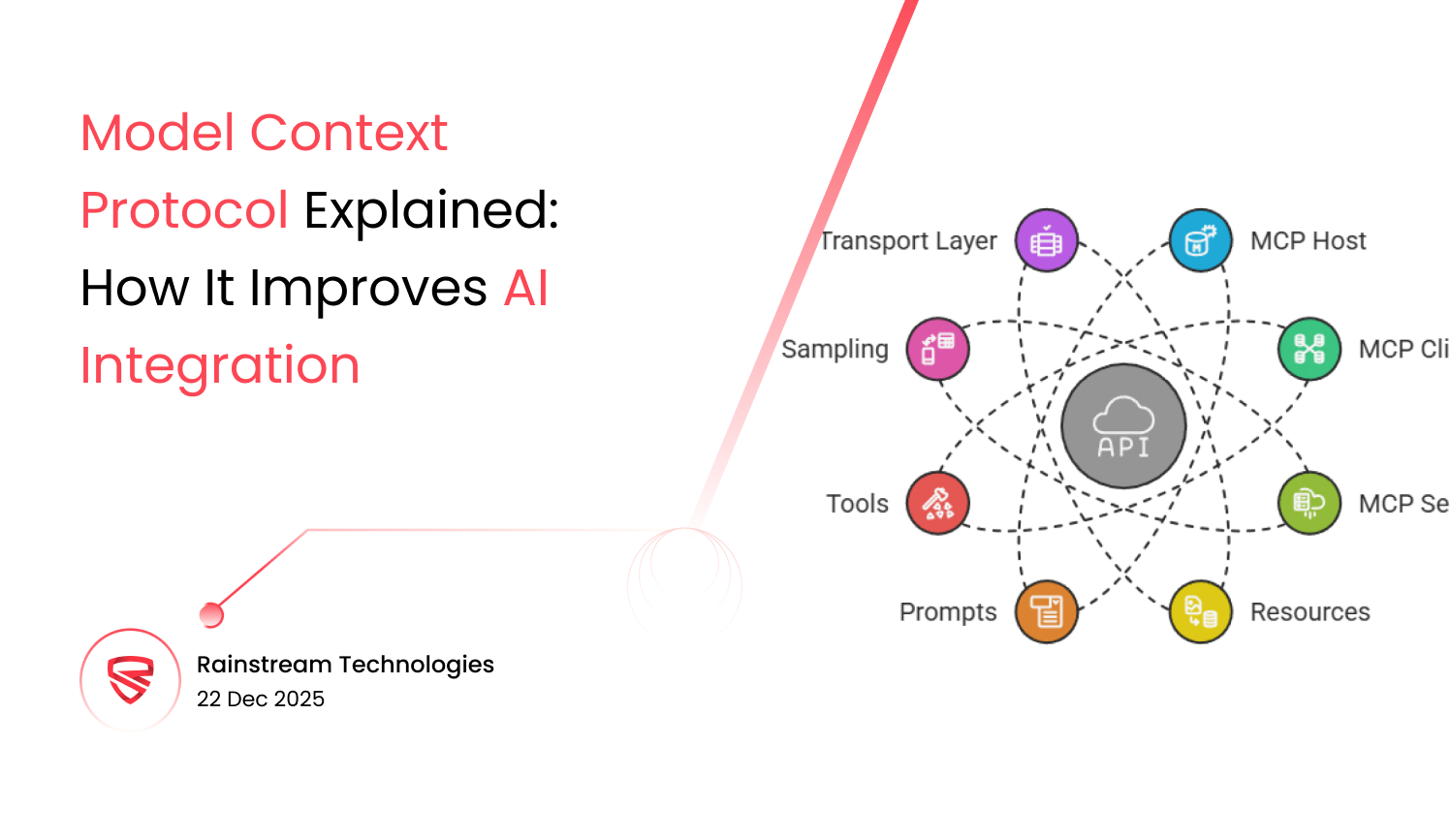
Model Context Protocol (MCP) organizes AI interactions with tools and data in a structured way. It divides thinking, data retrieval and activity into distinct layers whereby AI models are concerned with intelligence whereas MCP is concerned with execution and context.
The typical flow of MCP in an enterprise environment can be visualized in these steps:
Step 1: Request Initiation
The AI model is given a user query or task and identifies what external information or a task is required.
Step 2: Client Communication
The model’s client sends a structured request to the MCP server, specifying required tools, data or workflows.
Step 3: Server Processing
The MCP server routes the request to the appropriate handler which may access databases, APIs or other systems.
Step 4: Context Handling
The server maintains session state, storing temporary or persistent data to ensure continuity across multiple requests.
Step 5: Response Delivery
The server sends the processed information or results back to the client.
Step 6: Action Execution
If needed, the client uses the response to trigger workflows or update systems, completing the automation cycle. This architecture allows enterprises to connect AI models securely and efficiently without writing custom integrations for every system.
Why is MCP Important for Enterprise AI?
MCP ensures enterprise grade governance by enforcing clear rules for AI to data interactions. It provides secure AI to data access so sensitive information stays protected while models operate effectively.
By standardizing context and workflows, MCP delivers predictable AI behavior, reducing unexpected outcomes and operational errors. Organizations experience reduced operational risk because integrations are consistent and easier to monitor.
MCP supports long term AI scalability, allowing enterprises to add new tools, services or data sources without rewriting pipelines. This makes MCP consulting services essential for businesses aiming for reliable, compliant and efficient AI deployments at scale.
Secure Context & Data Access with MCP
MCP makes sure AI interacts with data safely through permission based access and least privilege execution. This will enable regulated AI behavior and still be compliant. Businesses can control the listed viewers and consumers of sensitive data.
A model context protocol development company can help implement security policies that align with regulatory standards. The implementation of Secure MCP ensures that all activities are tracked, audited and separated to avoid breaches of the security system or information leakage.
- Role-based access control: Permissions are granted according to the user roles or AI roles.
- Audit & monitoring layer: Supervises operations to support transparent accountability.
- Data isolation: Stores data independent of one another.
- Compliance-readiness: Promotes regulatory and industry standards.
MCP for Tool, API and Database Connectivity
MCP offers a single interface to interface AI models with tools, APIs and databases. This will do away with the use of multiple point to point integrations. This makes it less complex and makes the maintenance overhead less.
Enterprises can rely on an MCP implementation partner to integrate systems securely and efficiently. With MCP, AI can safely execute actions across databases and services without custom coding for each connection.
- Database connectors: Access multiple databases through a single protocol.
- Secure API bridges: Connect APIs safely without direct exposure.
- Search & retrieval modules: Fetch relevant data quickly.
- Workflow triggers: Automate actions based on events.
- Model-safe execution sandbox: Run AI operations without risking system integrity.
Scalability & Maintainability Benefits of MCP
MCP allows businesses to develop AI systems that evolve as the business requirements change. It has a simple update process as its connectors are modular and execution remains consistent even between teams. This will ensure reliability in the long term and ease of AI operations.
Organizations using MCP for AI automation reduce complexity and technical debt. New integrations or updates do not require restructuring the current working processes which facilitates the provision of new features in short periods and reduced maintenance expenses.
- Reduced technical debt: Avoid repeated custom integrations.
- Lower maintenance costs: It is easier to update as a result of which fewer resources are spent.
- Faster feature delivery: Deliver new capabilities rapidly.
- Consistent execution across teams: Standardized processes reduce errors and misalignment.
Real World Use Cases of MCP in AI Systems
MCP’s structured approach makes it easier for enterprises to adopt AI safely and efficiently. With consistent context and controlled access, organizations are able to deploy AI in a number of systems without affecting security or reliability.
- Enterprise AI Assistants
MCP permissions allow AI assistants to have secure access to internal tools and data. This guarantees that responsive actions are taken within the policies of the organization and sensitive information is never disclosed to unauthorized owners.
Businesses can give AI assistants with broad capabilities without compromising uncontrolled activities.
- AI-Driven Workflow Automation
MCP allows real time workflow triggers among tools and systems. Automatic processes such as approvals, notifications or generating reports can be undertaken and maintain an audit trail. Teams become aware of AI activities. This ensures that there is compliance and operational safety.
- Multi-Tool AI Orchestration
Enterprises can coordinate SaaS applications, APIs and databases through a single MCP interface. Modular reusable integrations lower the development burden and accelerate and predict expansion of AI capabilities.
- Secure Data Query Systems
MCP enables AI to query live databases without being compromised with tight read/write restrictions. Developers are able to implement access control and data integrity. This will provide businesses with the assurance to use AI to store sensitive or regulated information.
Conclusion
Model Context Protocol is shaping the future of AI integration with its open & vendor neutral design. It facilitates model agnostic integration, accelerates the integration of new AI models and well supports enterprise governance.
If you need secure AI connections and scalable data workflows, then contact Rainstream Technologies for expert MCP implementation and support.
Their specialized team builds modular tools that streamline automation, helping organizations achieve faster delivery while reducing overall long term maintenance costs.
Frequently Asked Questions
Q1. What is the Model Context Protocol used for?
A. MCP is a standardized interaction interface of AI models with tools, databases and APIs. It guarantees organization, regulated performance and integration across systems.
Q2. How is MCP different from traditional AI integrations?
A. MCP provides a unified and model agnostic interface as opposed to a custom integration. It minimizes complexity, it does not have multiple point to point connections and allows predictable AI behavior across environments.
Q3. Is MCP secure for enterprise use?
A. Yes. MCP implements access control by role, audit logs, data isolation and execution by AI permission based. This makes it compliant with enterprise security and governance standards.
Prefer Rainstream ?
 Add to Preferred Sources
 Contact Us